Designing trust into a pet health AI.
A mobile tool for the moment you look inside your dog's mouth, think something looks wrong, and have no idea whether it's worth a vet visit.
The problem
Owners know oral health matters. They just can't tell which signs are worth a vet visit. We were briefed to close an education gap, and the research showed owners were already educated.
Who it's for
Pet owners in a moment of doubt, and the vets who end up fielding their questions. Mars teams were watching too, since the flow would be reused across other scan products.
The outcome
Owners leave with a specific question to bring their vet instead of a vague worry. Mars got non-diagnostic data across 17 markets, and reused the flow for PoopScan and PawScan.
A 30-second visual signal
A guided photo, four owner-reported symptoms, a tooth-by-tooth map, and a one-tap route to a vet.
A diagnosis
It doesn't name a disease or stand in for a vet. A clean result isn't permission to skip the check-up.
The problem
Awareness is high. Action isn't.
Three-quarters of owners already know oral health matters. But plaque and early gum irritation look like nothing much, general advice doesn't tell you whether your dog is the one with the problem, and there's no obvious point at which a vet visit becomes urgent. What owners lacked was a way to see something specific about their own dog.
80% of dogs over 3 have periodontal disease · 72% of owners rate their dog's teeth as good or perfect · 4% brush regularly.
Core principles
Three constraints I set early.
Each came out of the research, and each one cost us something to hold onto.
Design the refusals first
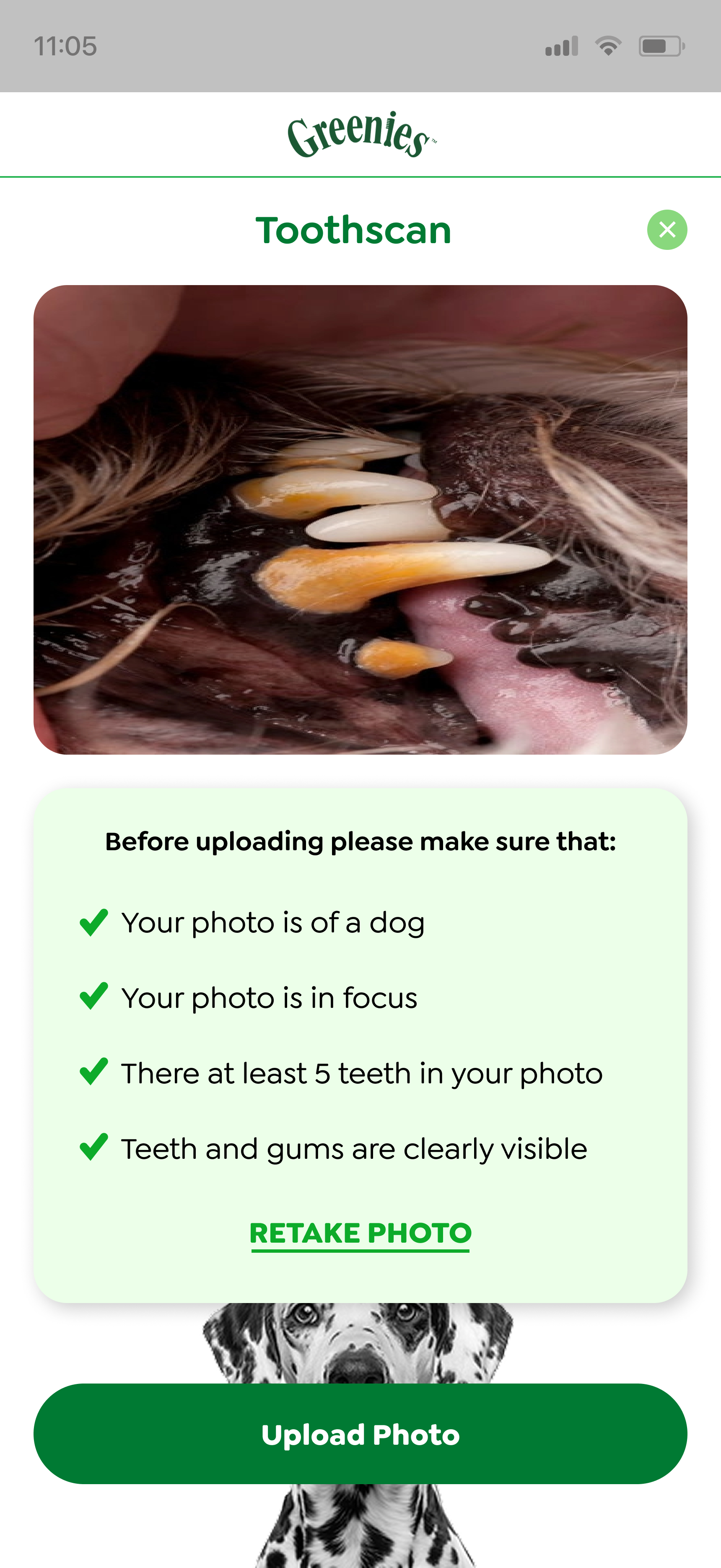
The model can decline a photo for several reasons, and most of them come down to how the owner framed the shot. I designed five refusal states before the success state, each one naming what to change and letting the owner retake without starting over.
Ask the owner what they've noticed
Owners hold information a camera can't reach: breath, bleeding, whether the dog flinches while eating. Four questions capture it, and those answers travel into the result and the vet handoff rather than sitting in analytics.
Every result ends on a next step
Alert, clear or refused, each terminal state routes toward a vet conversation. The clean scan was the risky one: it had to close without implying the check-up was now optional.
See it work
Six screens, start to vet handoff.
Scroll through the flow. The phone stays put and the screen changes with each step.
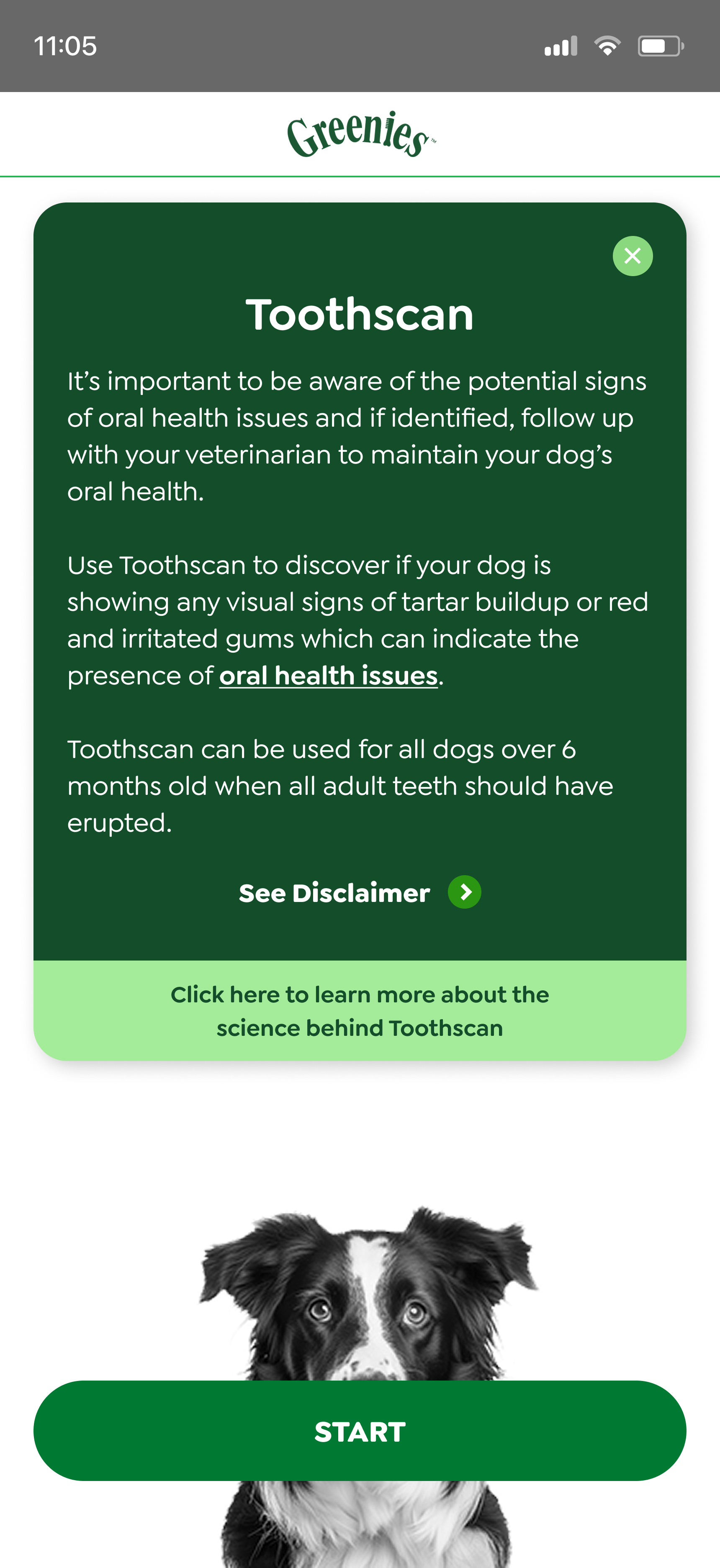
Say what it is before asking for anything.
The home screen states that ToothScan is informational and links to the full disclaimer before the owner uploads a thing. Legal wanted it discoverable. I wanted it on the first screen, where it actually changes what the owner expects to get back.
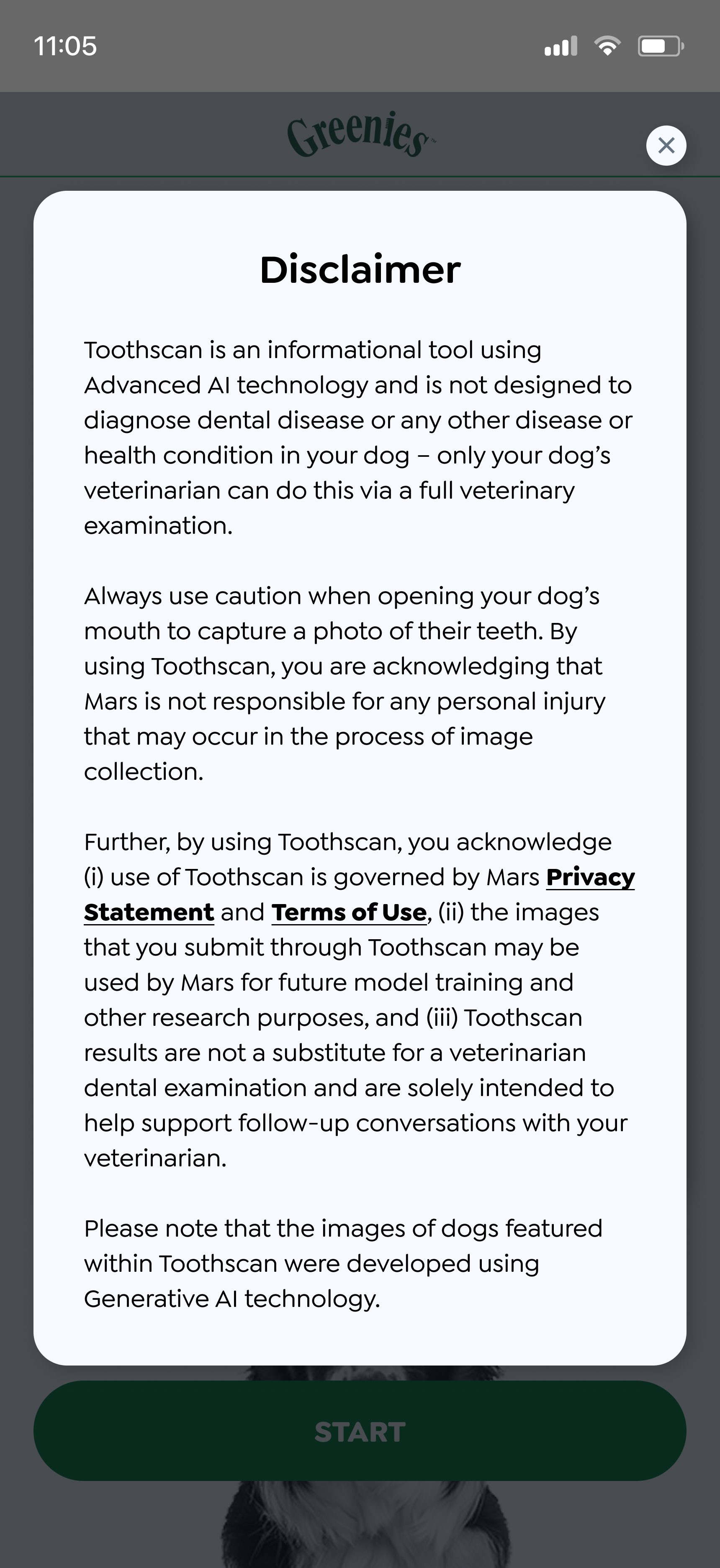
A full screen for the disclaimer.
It opens as a modal in plain language, with no fast path around it. Mars' published model methodology sits one tap from the home screen, which is unusual for consumer AI.
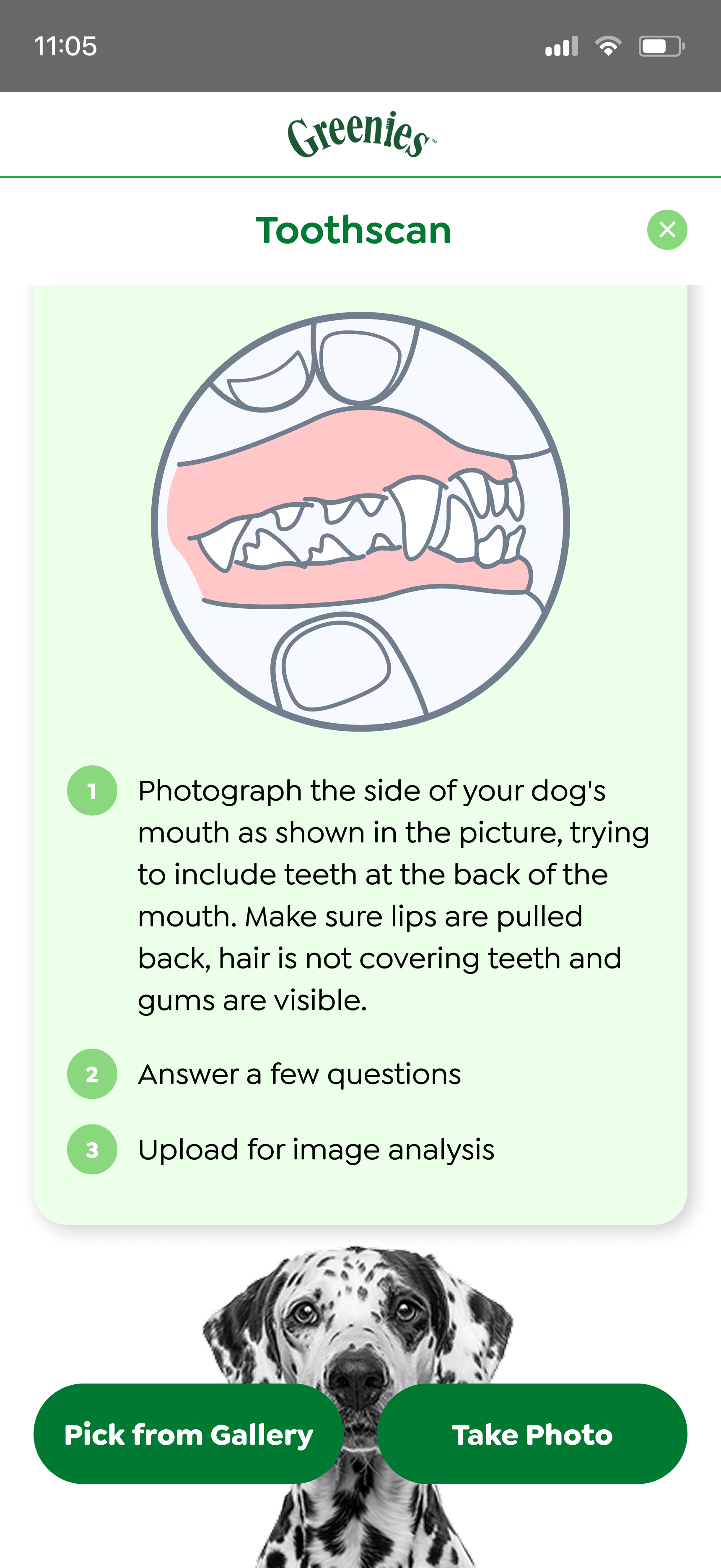
Teach the photo.
The model is only as good as the image it gets, and a dog's mouth is a hard subject. Three illustrated steps show the framing: lips pulled back, back teeth in shot, fur out of the way. Most owners correct themselves here, which is far cheaper than a refusal two screens later.
Four questions alongside the photo.
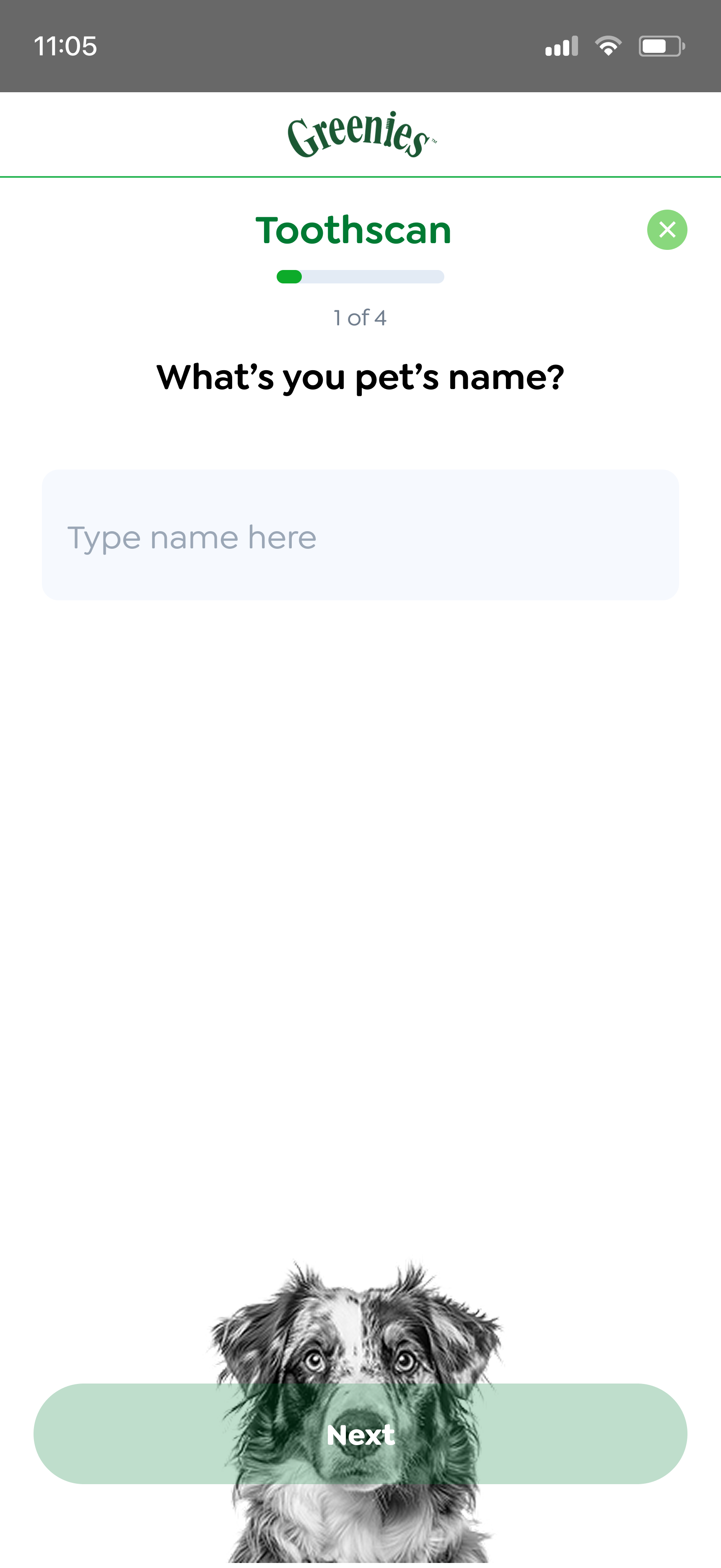
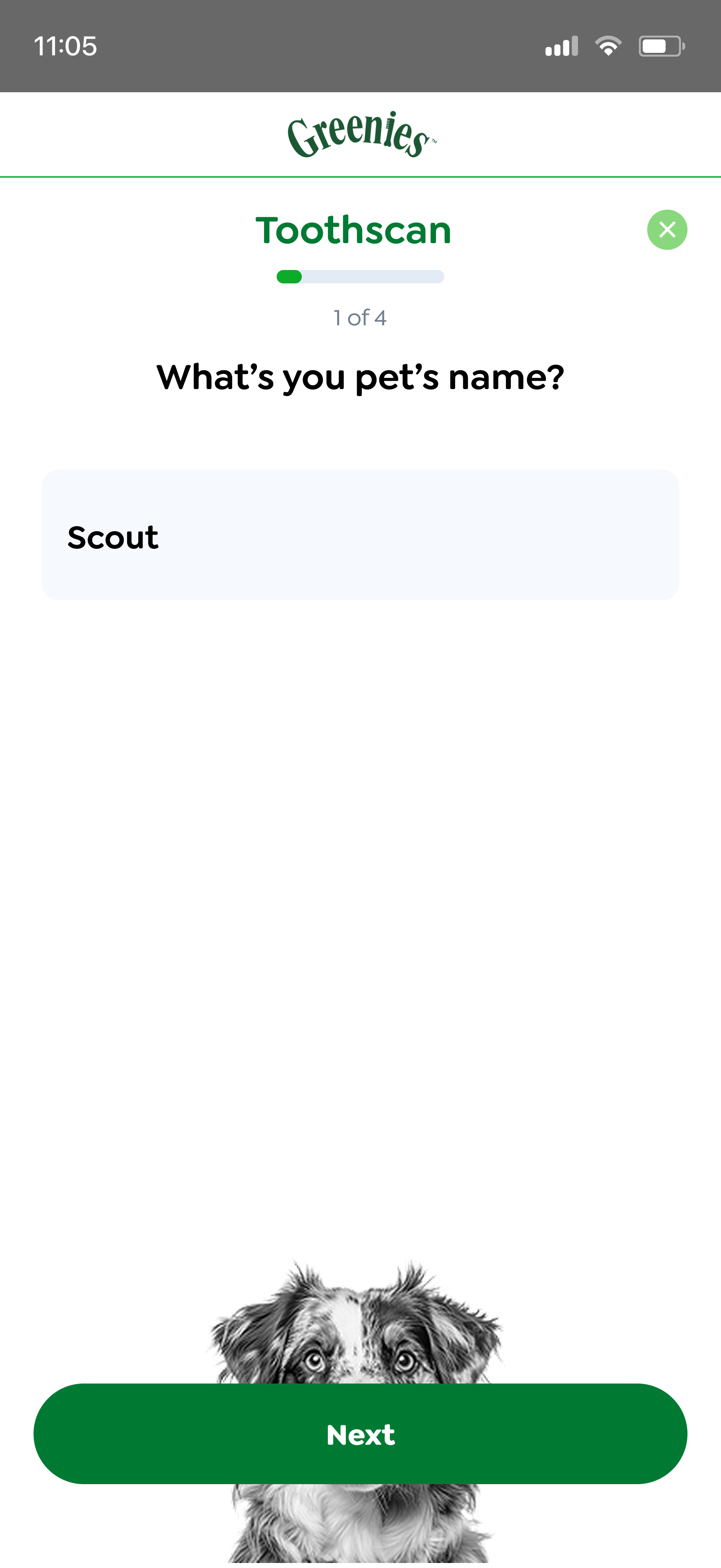
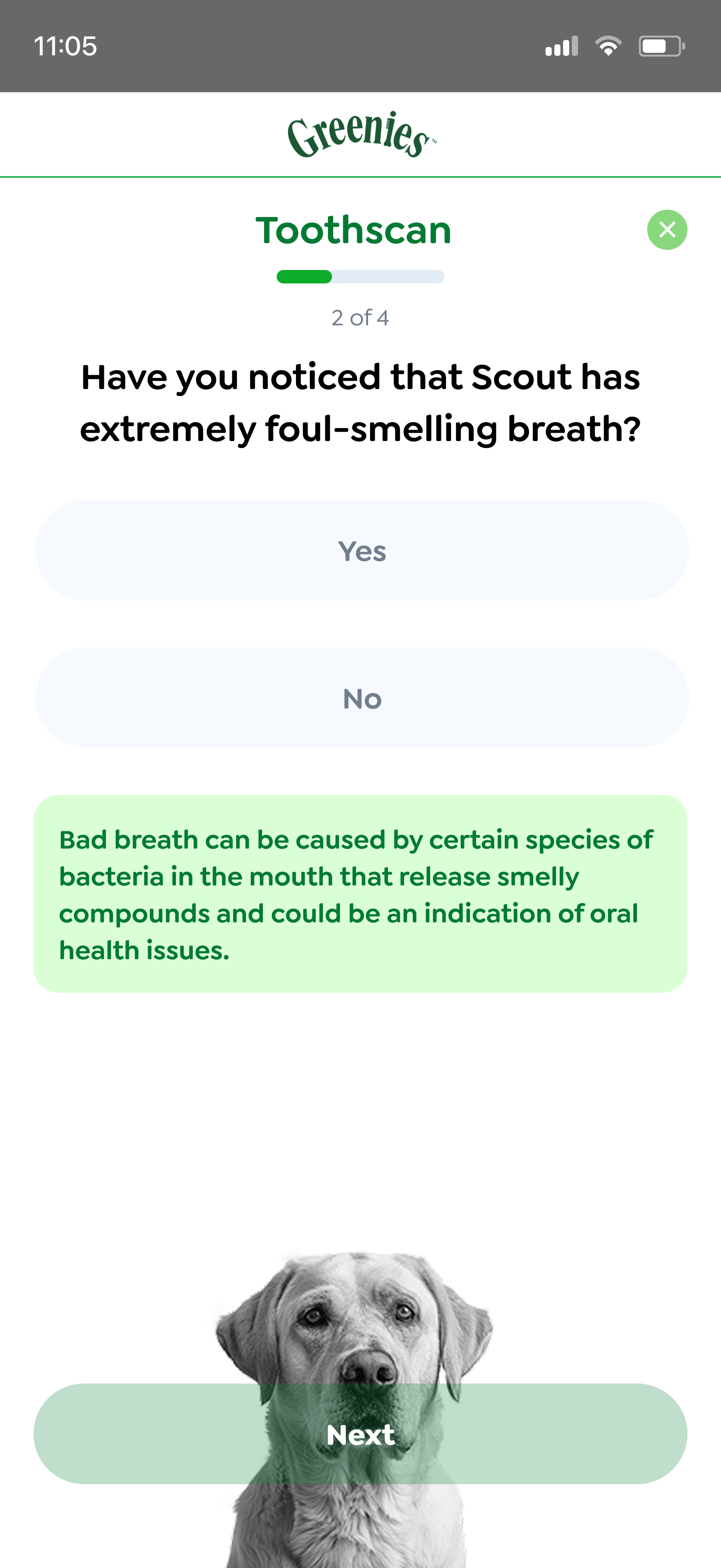
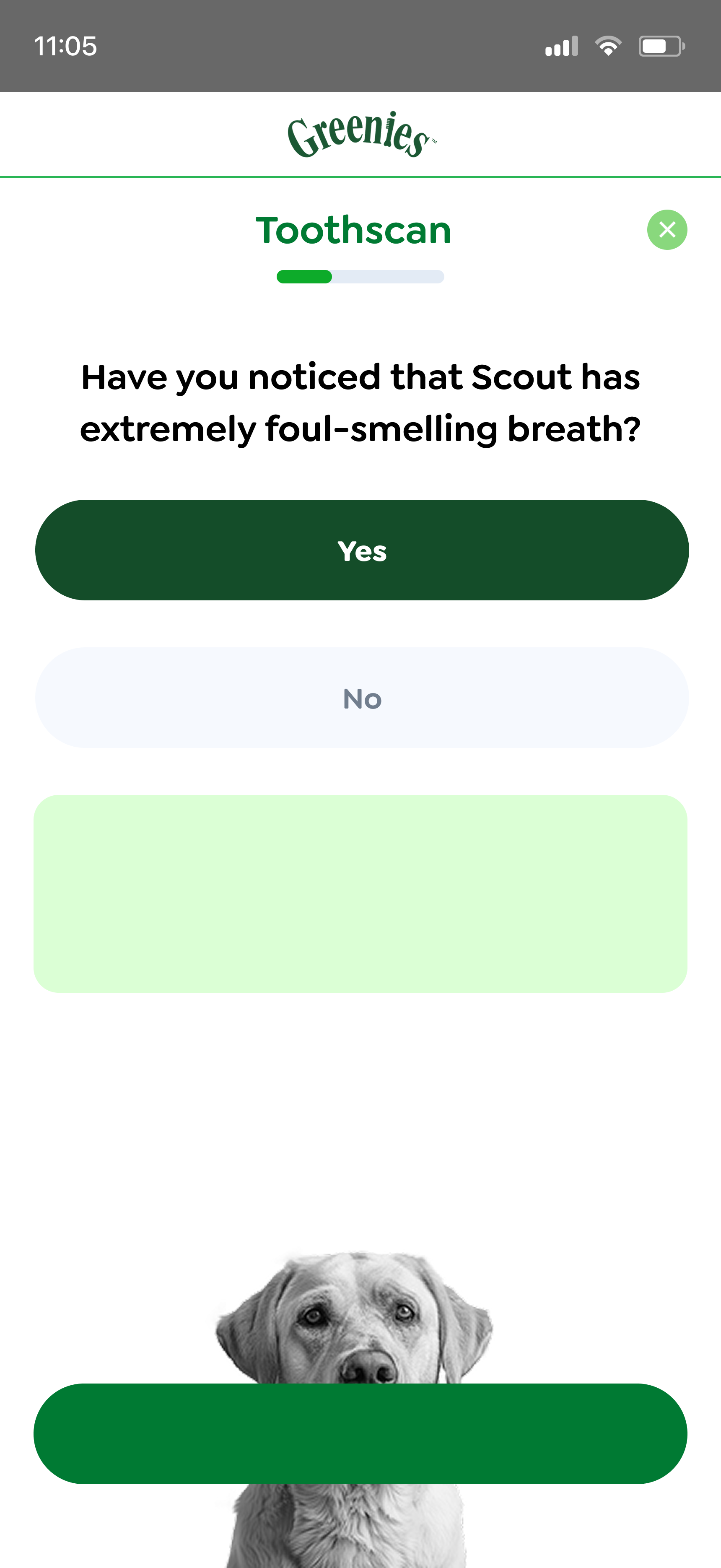
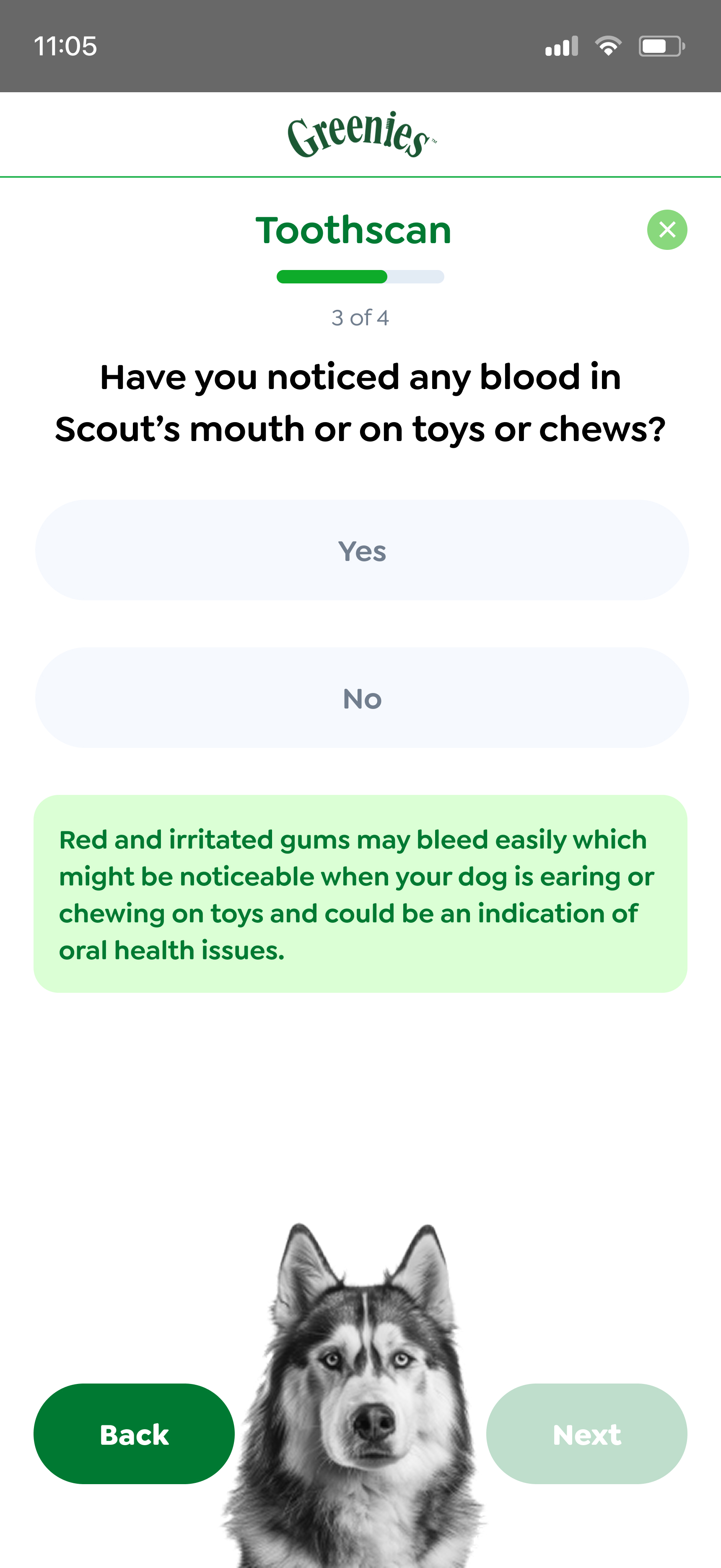
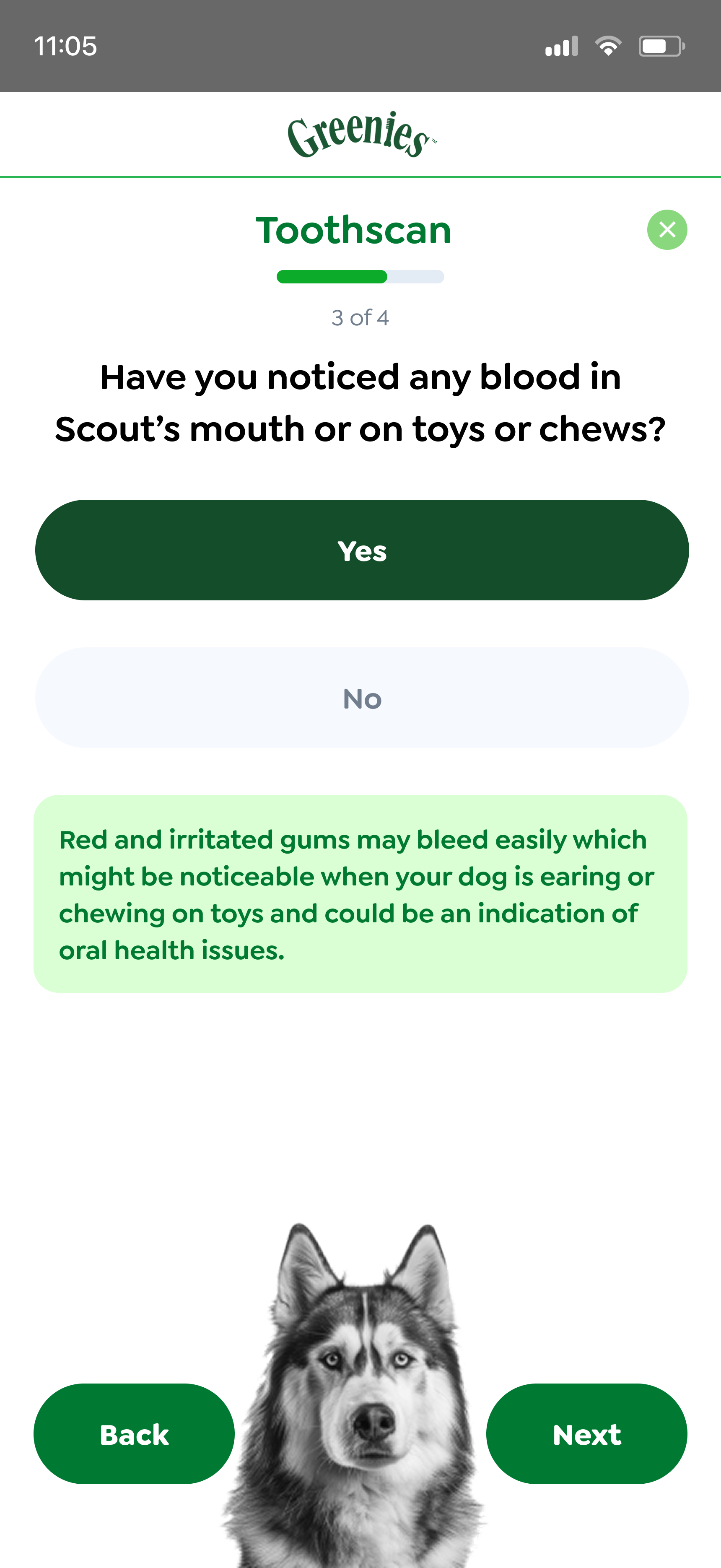
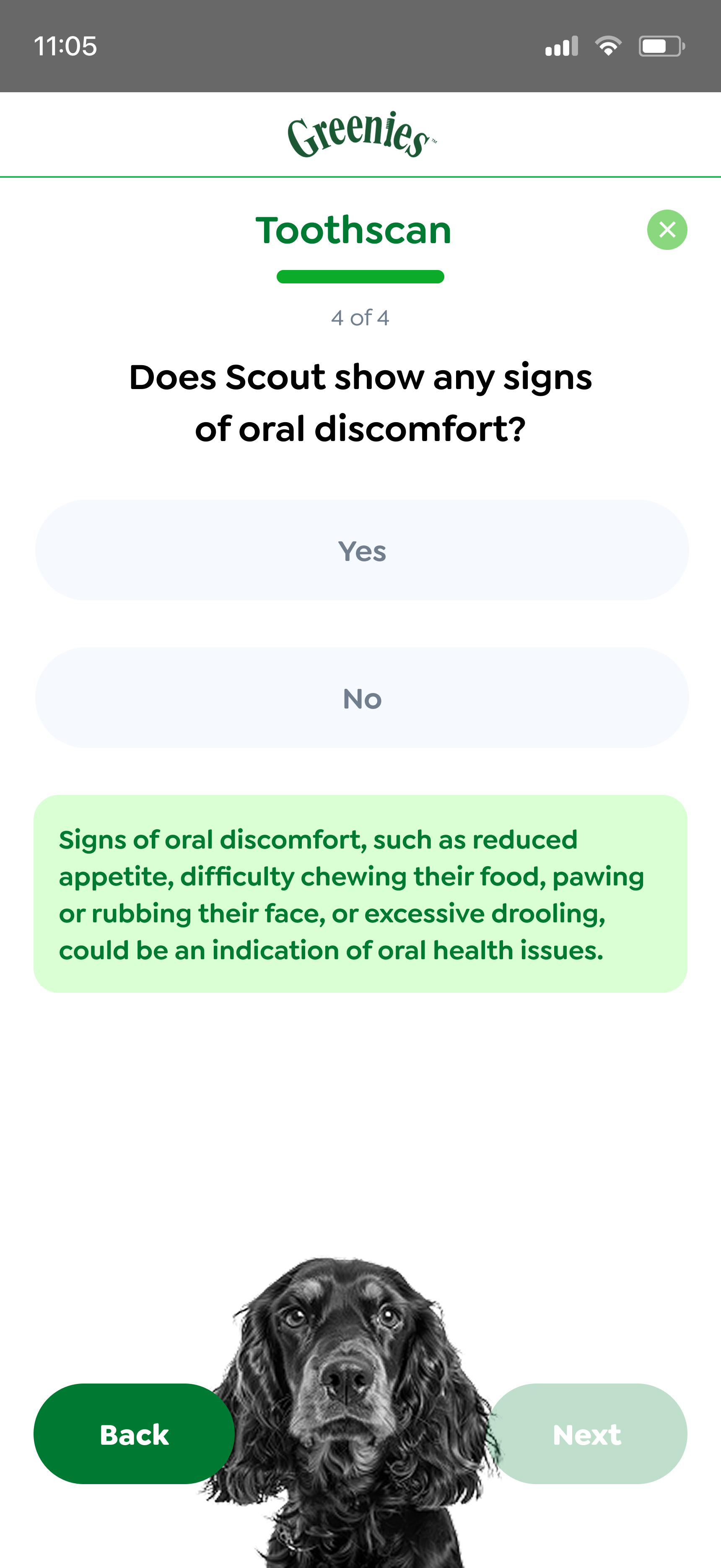
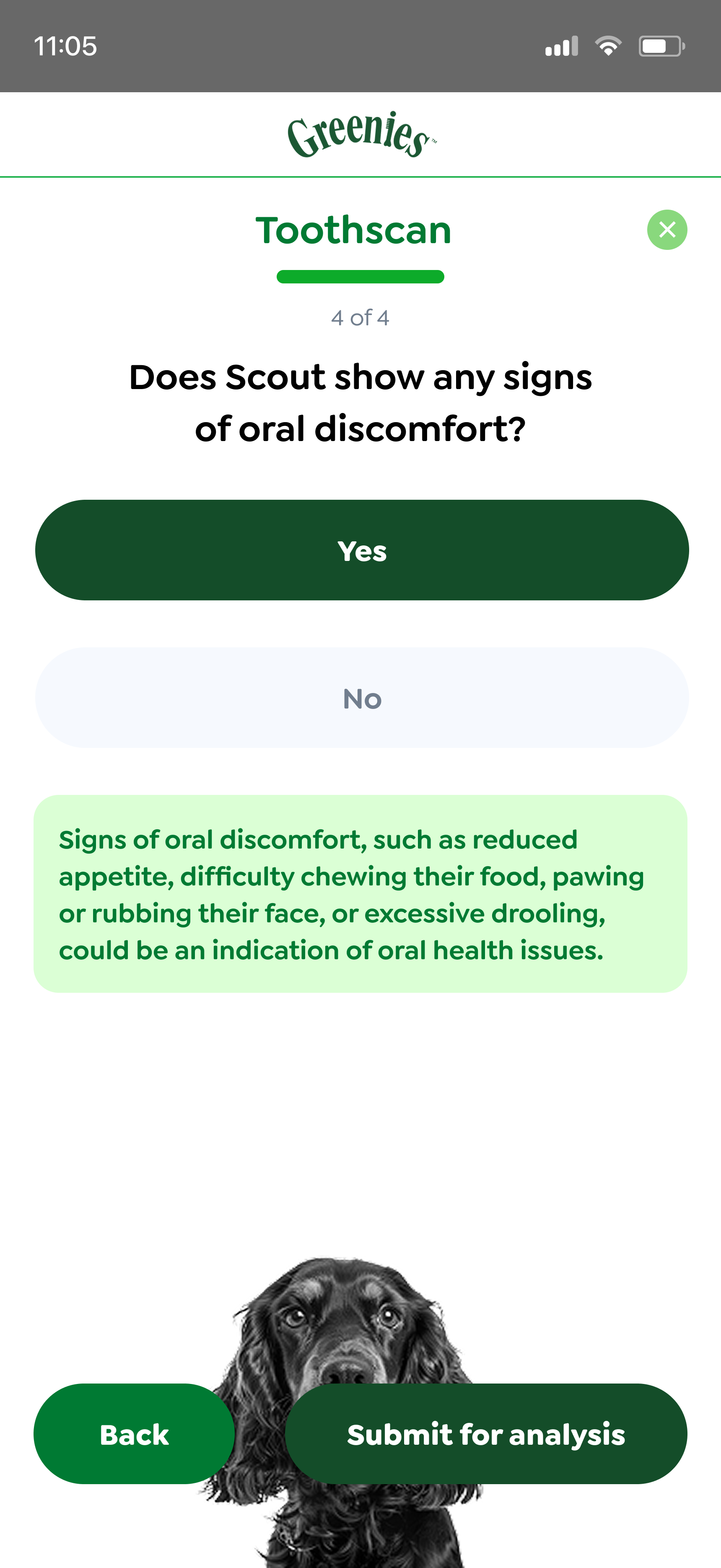
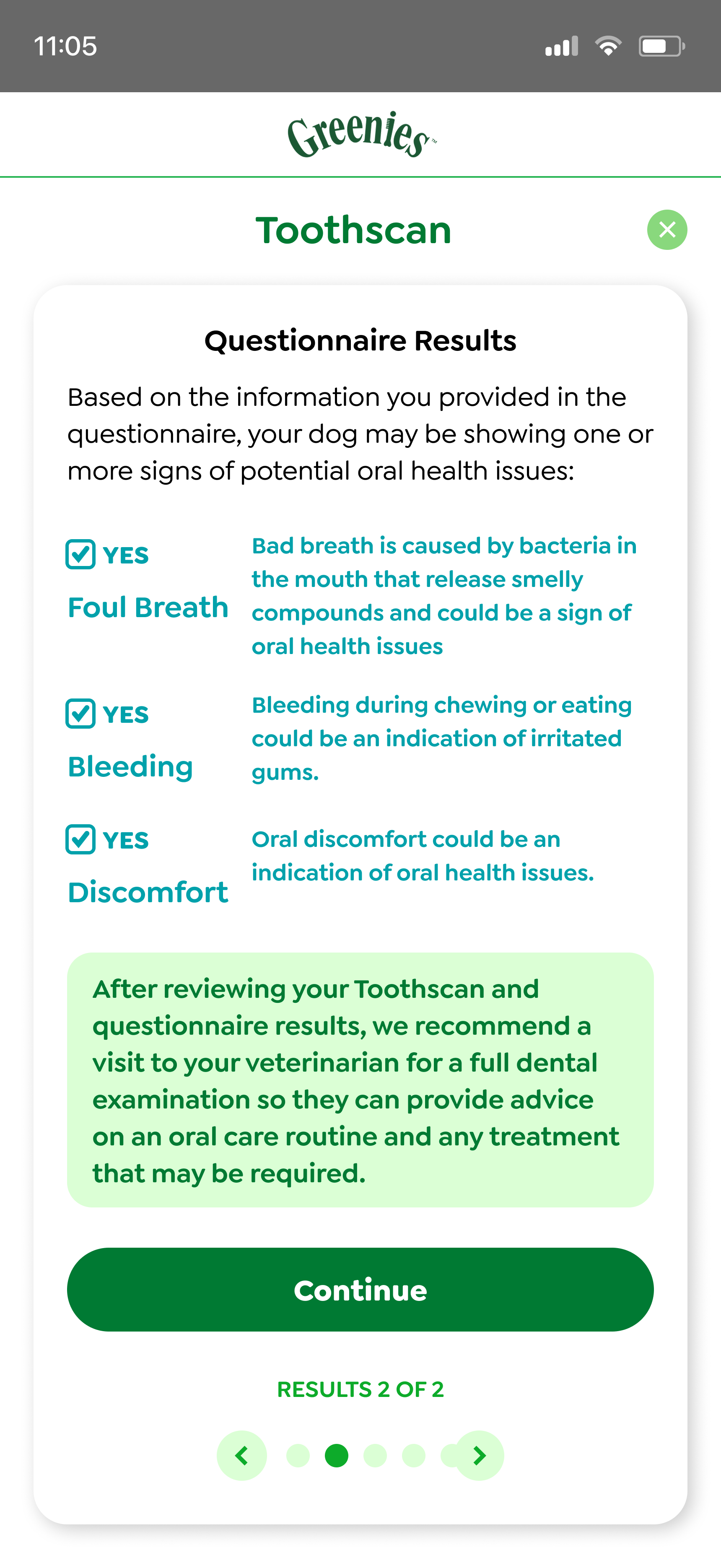
Name, foul breath, bleeding, discomfort. Each "yes" opens a short explainer, so the education lands while the owner is already paying attention rather than in a content section nobody visits. The answers show up in the result and in whatever gets sent to the vet.
Show what the model saw.
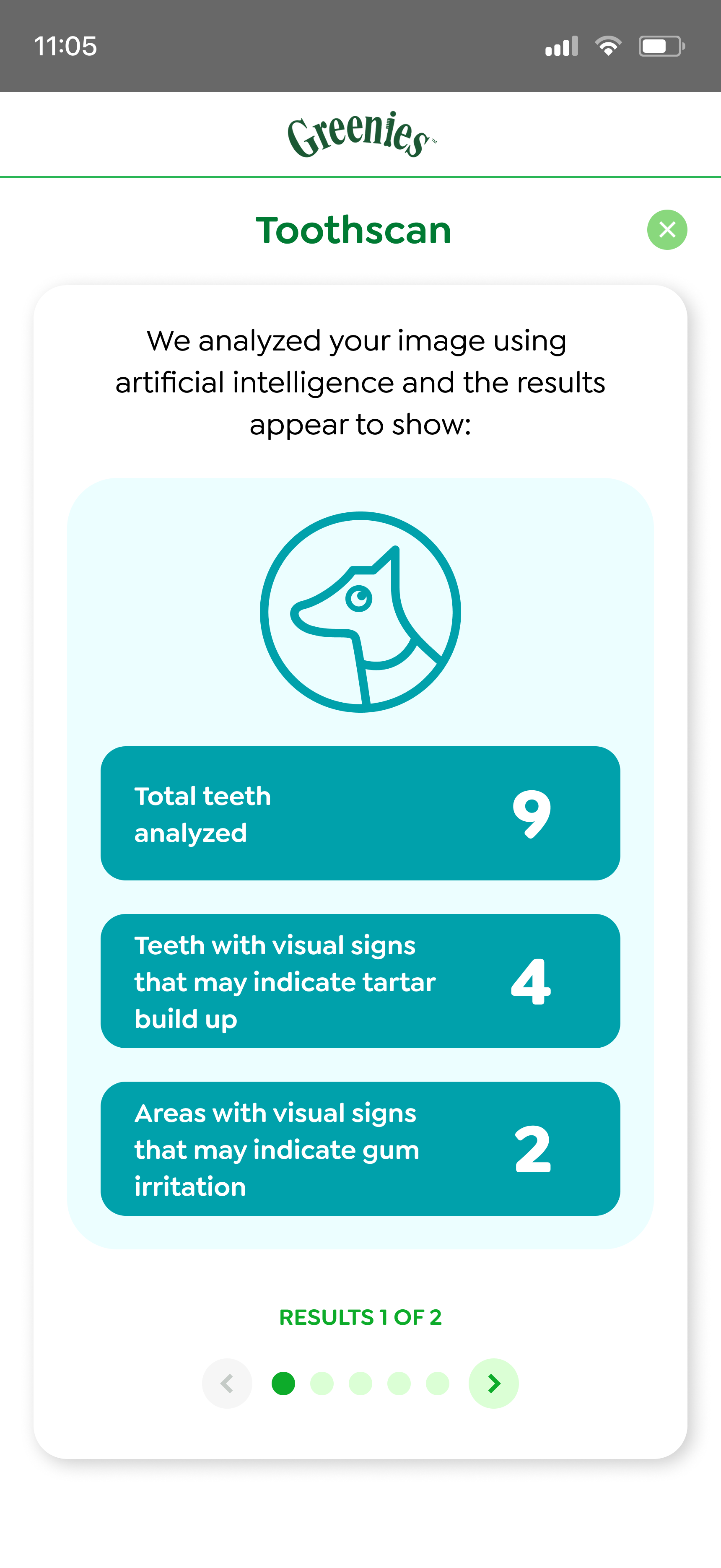
Three counts: teeth analysed, teeth with visible tartar, areas with possible gum irritation. Counts, not verdicts. The number tells the owner where to look and leaves the reading of it to a vet. The questionnaire answers sit right beside them.
The team's language rule: flag, suggest, share. Never diagnose.
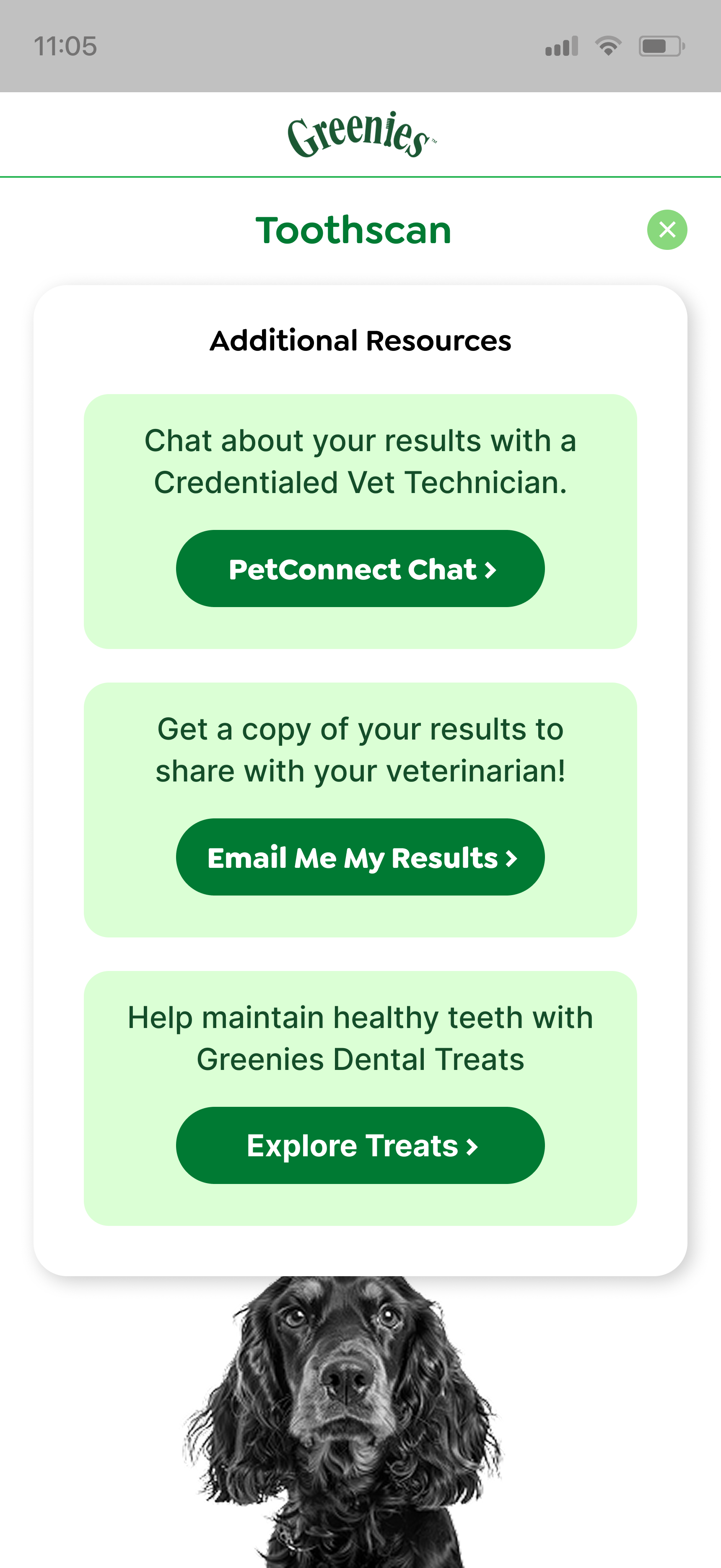
Hand the result to someone who can help.
Two routes out: chat with a credentialed vet technician, or email the results to take into your own clinic. Both carry the full context, so nothing has to be re-explained from memory: questionnaire answers, model findings, the photo itself.
A vague worry becomes a specific question.
The hard call
How do you say something useful without saying anything diagnostic?
The result page had to satisfy three groups who wanted different things from it, and any version that fully satisfied two of them broke the third.
"Just tell me if my dog has gum disease."
Wants a clear answer they can act on.
"Don't pretend you can replace me in the consult."
Wants the model to defer to clinical judgment.
"Don't make a clinical claim you can't defend."
Wants zero diagnostic language anywhere in the UI.
The result page reports what was counted and leaves the interpreting to a vet: tartar per tooth, irritation per gum area, plus every symptom the owner reported. The verbs stay structural throughout: flag, suggest, share with your vet. The word has is never used as a conclusion anywhere in the copy. The clean-scan state still ends on a vet CTA, because that was the state most likely to be read as permission.
None of the three got the version they asked for. It took three full rewrites of the result-page copy to find one all of them could sign off on.
Under the hood
Nine model stages behind one screen.
Owners see a single uninterrupted flow. Underneath, the image passes through nine model stages: three that decide whether to proceed, four that extract signal, two that quality-check before anything reaches the screen. Three of them can stop the flow outright, which is why the refusal states mattered as much as the result page.
Receive image
Capture or upload
Dog finder
Is this a dog?
Body part
Is this a mouth?
Tooth ID
Locate each tooth
Tartar?
Per tooth
Gum ID
Locate gingiva
Irritation?
Per gum line
Quality
Blur, noise, light
Return
API → UI
Vet-supervised training
Every training image was labelled by a licensed vet, so the outputs map onto signal a clinician already recognises.
3rd-party scientific governance
External review of the methodology and performance. Mars publishes the methodology openly, and we treated that page as a design surface rather than legal boilerplate.
Designed refusal
Stages 02, 03 and 08 can stop the flow. Each has its own written state, and each one names what to change. "We can't read this photo" is safer than a guess.
The finding we didn't expect
A consumer tool became a research instrument.
"How do we transform awareness into action? By making oral health visible."
Mars Petcare · 2024 product conference
That wasn't only marketing. Once submissions arrived at volume they showed patterns no clinic dataset could, because clinics only ever see the dogs that already got brought in. One of those patterns validated the whole premise.
where owners reported foul breath
where owners reported no symptoms
Owners who sensed something was wrong were usually right. What they'd never had was anywhere to put that instinct.
17 markets · methodology published on mars.com
Impact
Where it landed.
Markets live
EU, Asia and the Americas. The flow was localised without changing the disclaimer hierarchy, the handoff or the refusal states.
Photo → PDF
Median end-to-end time, questionnaire included.
Diagnostic claims
Across every result state in every locale. Audited with vets, then regulatory.
Of scans in 6 markets surfaced signal
Reopening the question of true periodontal prevalence in the general dog population.
Reflection
I came in thinking the design problem was the model. I left thinking it was the disclaimer.
The model had a team and a roadmap behind it. The part nobody owned was the thirty seconds before any data gets collected: the disclaimer, the photo instructions, the wording on the result page. That's where an owner decides how much to trust the thing.
Any AI product in a domain where being wrong matters has a moment where it has to tell the user what it can't do. Skip it and the quality of the model output stops mattering much, because the user has already decided what weight to give it.
For the next product I build, I'd start with the disclaimer and work backwards.
I'd put a veterinarian on the design pod in week one. We rewrote the result-page language three times (clinical accuracy, then owner readability, then regulatory sign-off) and each rewrite invalidated layout decisions we'd already committed to. A vet in the room from the start would have made those constraints part of the first sketch.
A longitudinal view. Right now ToothScan is a single snapshot. The same pipeline could show an owner the same dog's mouth six months apart, which is the version a vet would actually find useful.